


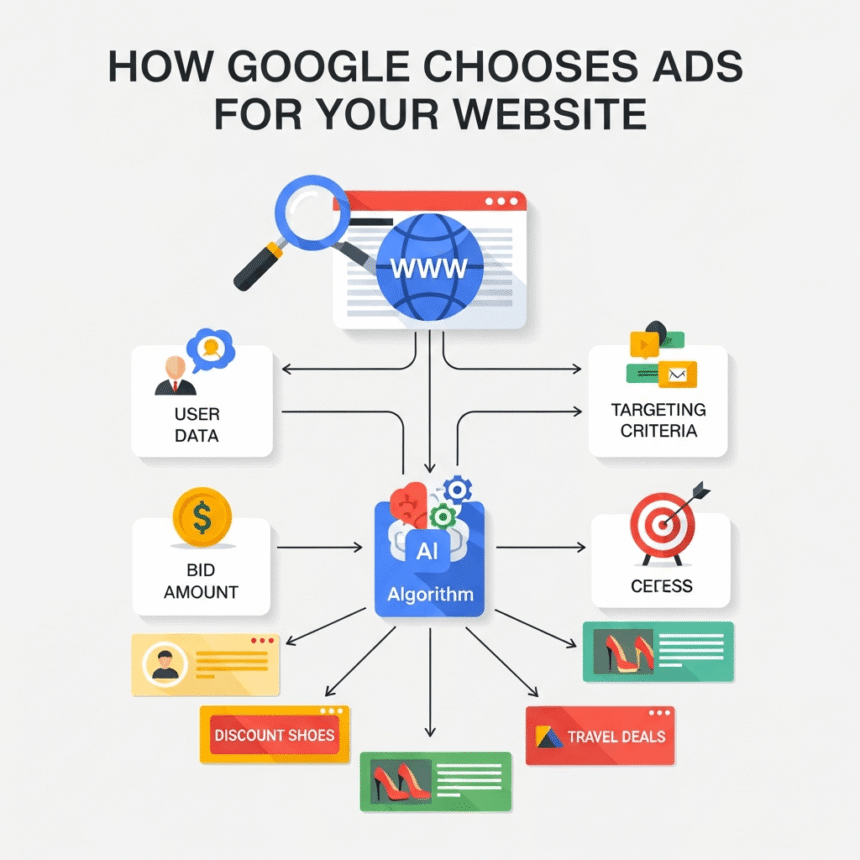
Have you ever wondered why you see an ad for hiking boots right after reading a travel blog, or why a local pizza shop pops up while you are browsing the news? It often feels like the internet is reading your mind, but it is actually a very organized system at work.
Google uses a complex process to decide which ads appear on a website. This process happens in the blink of an eye, involving millions of calculations to ensure that the ad is a good fit for the reader and the website owner.
Here is a simple look at how Google chooses the ads you see.
1. Matching the Content (Contextual Targeting)
The first way Google picks an ad is by looking at what is on the page right now. This is called contextual targeting.
Google’s system scans the website to understand the main topic. It looks at:
- The words and phrases used in the text.
- The headers and titles of the article.
- The overall theme of the site.
If you are reading an article about “How to Grow Tomatoes,” Google understands the context is gardening. It will then look for advertisers who want to show ads to people interested in seeds, soil, or garden tools. This makes the ad feel like a natural part of the page.
2. Understanding the Visitor (Personalized Advertising)
Sometimes, the ads you see are not about the page you are reading, but about you and your interests. This is known as personalized advertising.
Google looks at “signals” from your previous activity to guess what you might like. These signals include:
- Previous Searches: If you searched for “best laptops” earlier in the day, you might see laptop ads later on a completely different website.
- Your Location: Google often shows ads for businesses near you. If you are in Chicago, you are more likely to see ads for Chicago dentists than ones in New York.
- Demographics: Based on your settings and activity, Google might show ads tailored to your age group or language.
3. The Instant Auction
Every time a webpage loads, an invisible “auction” happens. Advertisers tell Google how much they are willing to pay to show their ad to a specific type of person or on a specific type of site.
However, the winner is not always the one who offers the most money. Google also cares about quality. They use a “Quality Score” to measure:
- How relevant the ad is to the user.
- How likely the user is to click it.
- Whether the website the ad links to is safe and helpful.
If an advertiser bids a lot of money but their ad is annoying or irrelevant, Google might choose a lower-priced ad that is much more helpful to the reader.
4. Language and Device
Google also checks technical details before placing an ad. For example, if your website is written in Spanish, Google tries to show ads in Spanish.
The system also looks at the device you are using. If you are on a mobile phone, Google might prioritize ads that have a “Call” button or a link to a mobile app, rather than a heavy website that takes a long time to load on a small screen.
Summary
Google’s goal is to create a win-win situation. They want the reader to see ads that are actually useful, the advertiser to find the right customers, and the website owner to have ads that fit their content. By combining what is on the page with what the user is interested in, Google ensures the ads you see are as relevant as possible.