


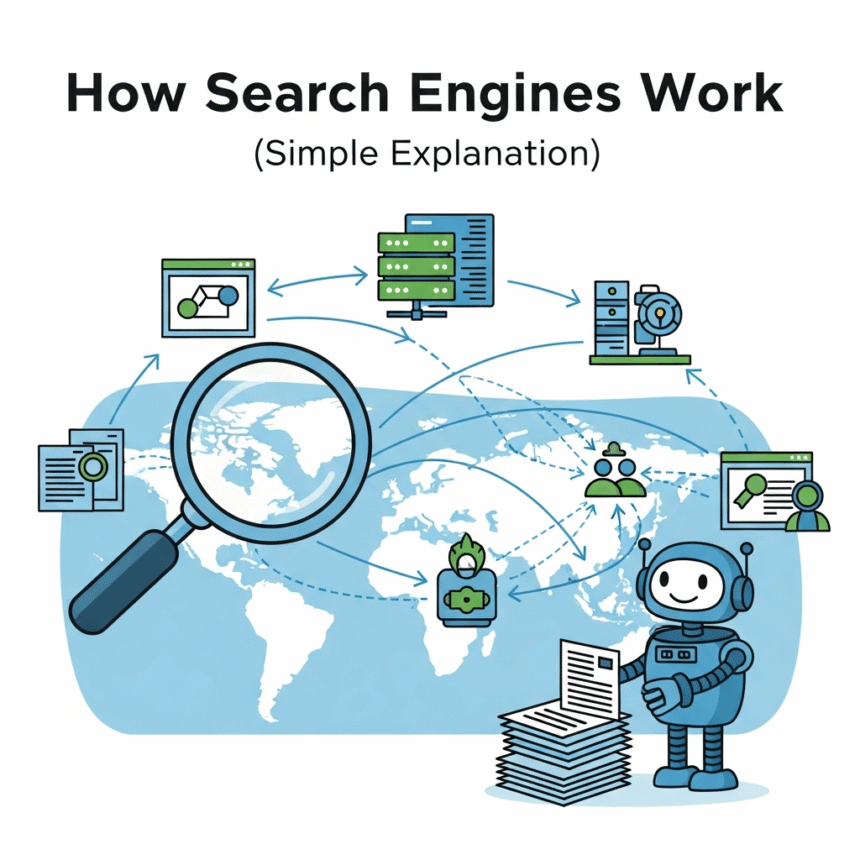
Have you ever wondered how Google or Bing can find exactly what you are looking for in less than a second? The internet is a massive place with billions of pages, yet search engines manage to organize all that information almost instantly.
To understand how they do it, you can think of a search engine like a giant digital librarian. This librarian has read every book in the world and knows exactly which page contains the answer to your question.
The process happens in three main steps: Crawling, Indexing, and Ranking.
1. Crawling: Finding the Information
The first step is discovery. Search engines use special software programs called crawlers or spiders. These bots start by looking at a few web pages and then follow the links on those pages to find new ones.
As they move from link to link, they find new websites and updated content. If a website has no links pointing to it, the search engine might never find it. This is why links are often called the “threads” that hold the web together.
2. Indexing: Organizing the Data
Once the crawler finds a page, it doesn’t just leave it there. It “reads” the content and stores it in a massive database called an index.
Think of the index like the index at the back of a textbook. Instead of searching the whole book, you look at the index to find the page number for a specific topic. The search engine index stores information about:
- The words on the page.
- The type of content (images, videos, or text).
- When the page was last updated.
- The quality of the information.
When you search for something, you aren’t actually searching the live internet. You are searching the search engine’s index of the internet.
3. Ranking: Picking the Best Results
This is the most important part. When you type a word into the search bar, the search engine looks through its index to find every page that matches your request. Usually, there are millions of matches.
To decide which ones to show you first, the search engine uses a set of rules called an algorithm. The algorithm looks at hundreds of factors, including:
- Relevancy: Does the page actually answer your question?
- Authority: Is the website trustworthy and well-known?
- User Experience: Does the page load fast? Is it easy to read on a phone?
- Location: If you search for “pizza,” the engine will show you shops near you rather than shops in another country.
Why This Matters for You
Understanding this process helps you see why quality matters. If you want your website to be found, it needs to be easy for spiders to crawl, clear enough for the index to understand, and helpful enough for the algorithm to rank it highly.
Search engines are constantly getting smarter. Their goal is always the same: to give the user the best possible answer as quickly as possible.