


If you want your website to show up on the first page of Google, you need to understand SEO. SEO stands for Search Engine Optimization. It is the process of making your website better so that search engines like Google can find it and show it to people.
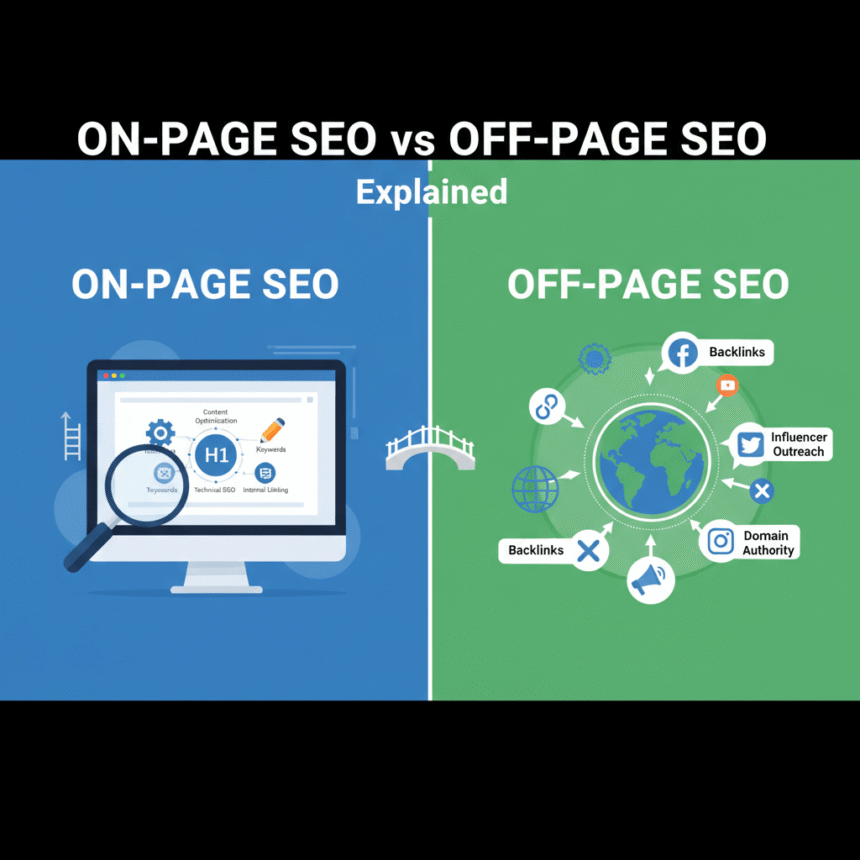
SEO is usually divided into two main categories: On-Page SEO and Off-Page SEO. To be successful, you need both. Think of it like running a restaurant. On-Page SEO is everything inside the building, like the food quality and the decor. Off-Page SEO is everything outside, like word of mouth and reviews from food critics.
What is On-Page SEO?
On-Page SEO refers to the things you do directly on your website to help it rank higher. These are things you have total control over. When you optimize your pages, you are helping search engines understand what your content is about.
Key Elements of On-Page SEO
- Content Quality: This is the most important part. You must write helpful, original, and easy to read content that answers the reader’s questions.
- Keywords: These are the words and phrases people type into Google. You should include your main keyword in your title and throughout your text naturally.
- Title Tags: This is the clickable headline that appears in search results. It should be catchy and include your main keyword.
- Meta Descriptions: This is the short summary under the title in search results. It tells users why they should click on your link.
- Header Tags: Using headings like H1, H2, and H3 helps organize your content. It makes it easier for both humans and Google to read.
- Image Alt Text: Since Google cannot “see” images, you need to use alt text. This is a short description of the image that helps search engines understand what is in the picture.
- Internal Linking: This means linking to other pages on your own website. It helps visitors stay on your site longer and helps Google find all your pages.
What is Off-Page SEO?
Off-Page SEO refers to actions taken outside of your own website to impact your rankings. It is about building the reputation and authority of your site. You want the internet to see your website as a trustworthy source of information.
Key Elements of Off-Page SEO
- Backlinks: This is the most famous part of Off-Page SEO. A backlink is when another website links to yours. Google sees this as a “vote of confidence.” The more high quality websites that link to you, the more Google trusts you.
- Social Media: While social media likes do not directly help your ranking, sharing your content on platforms like Facebook or X (formerly Twitter) brings more people to your site. This can lead to more backlinks later.
- Guest Posting: This is when you write an article for another website. In return, they usually let you link back to your own site.
- Brand Mentions: If people are talking about your brand online, even without a link, it shows search engines that you are a real and popular business.
The Main Differences
The biggest difference is control. You have 100 percent control over On-Page SEO. You decide what to write, which images to use, and how the site looks.
Off-Page SEO is harder because you are relying on other people. You cannot force a famous website to link to you. You have to earn that link by creating great content or building relationships.
| Feature | On-Page SEO | Off-Page SEO |
| Location | On your website | Outside your website |
| Control | High | Low |
| Focus | Content and structure | Authority and trust |
| Main Goal | Help Google understand your site | Help Google trust your site |
Which One Is More Important?
You cannot choose one over the other. It is like asking if a car needs an engine or wheels.
If you have great Off-Page SEO but poor On-Page SEO, people will visit your site and leave immediately because the content is bad or the site is hard to use. If you have great On-Page SEO but no Off-Page SEO, your site might be amazing, but no one will ever find it because Google does not think you are “important” enough yet.
Summary
To grow your website traffic, start with On-Page SEO. Make sure your website is fast, easy to read, and full of great information. Once your “house” is in order, start working on Off-Page SEO. Reach out to others in your industry, share your work on social media, and focus on getting other sites to talk about you.
When you balance both, you give your website the best chance to reach the top of the search results.