


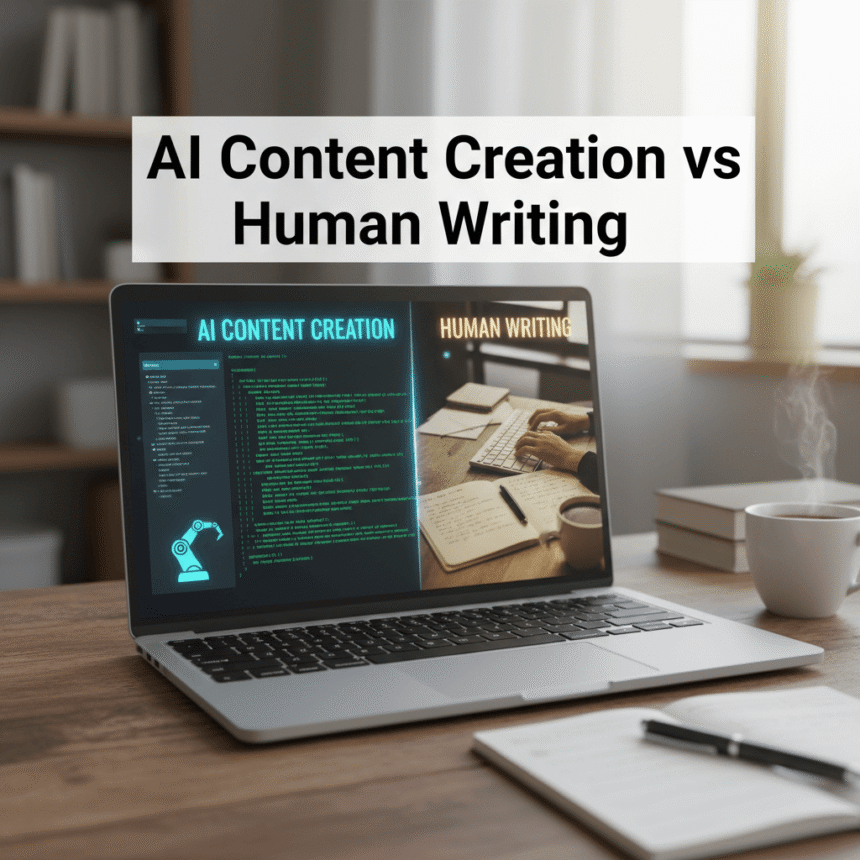
The world of writing is changing faster than ever. Not long ago, every word you read online was written by a person sitting at a keyboard. Today, artificial intelligence can generate entire articles in seconds. This has sparked a big debate: which is better?
If you are a business owner or a blogger, you might be wondering if you should switch to AI or stick with human writers. Both options have unique strengths and weaknesses. Understanding these differences can help you decide how to create the best content for your audience.
The Speed and Power of AI Content Creation
AI tools are famous for their incredible speed. A human might take several hours to research and write a 1,000-word blog post. An AI can do the same task in less than a minute. For businesses that need to produce a lot of content quickly, this is a massive advantage.
Another benefit of AI is its ability to handle data. If you need a report that summarizes thousands of customer reviews or explains complex statistics, AI is often more accurate and faster at finding patterns than a person. It also doesn’t get tired. It can write at 2:00 AM just as well as it does at 2:00 PM, and it never suffers from writer’s block.
However, AI has its limits. Because it learns from existing data on the internet, it cannot “think” of something truly new. It mostly repeats and reshuffles what has already been said. This can sometimes lead to content that feels repetitive or lacks a fresh perspective.
The Heart and Soul of Human Writing
While AI is fast, humans bring something that machines cannot yet copy: emotion and lived experience. A human writer knows what it feels like to be frustrated, happy, or inspired. They can use these feelings to tell stories that truly connect with a reader.
Human writing is also better at handling nuance and humor. A machine might struggle to understand sarcasm or a subtle joke, but a person can use these tools to make an article fun and engaging. Humans are also better at:
- Originality: People can come up with brand-new ideas and unique opinions.
- Trust and Empathy: Readers can tell when a person is sharing a real-life story, which builds a stronger bond between the writer and the audience.
- Deep Research: While AI can scan the web, a human can conduct interviews, visit locations, and verify facts in a way that ensures high accuracy.
The main downside of human writing is that it takes time and can be more expensive. People need breaks, and their writing quality can change depending on how they feel that day.
Finding the Right Balance
You don’t have to choose just one. In fact, many successful creators are now using a “hybrid” approach. This means using AI to do the heavy lifting and then having a human refine the work.
For example, you can use AI to create an outline or brainstorm titles. Once the machine gives you a starting point, a human writer can step in to add personal stories, check the facts, and make sure the tone matches your brand. This way, you get the speed of technology without losing the “soul” of human creativity.
Which One Wins?
The answer depends on your goals. If you need 50 product descriptions by tomorrow morning, AI is a great tool. But if you want to write a thought-provoking essay that changes how people think, you need a human.
In the end, readers want value. They want to learn something new or feel understood. Whether a machine or a person starts the draft, the goal remains the same: to help the reader. By focusing on quality and authenticity, you can make sure your content stands out, no matter how it was created.